Forum Replies Created
-
AuthorPosts
-
-
June 29, 2015 at 1:25 pm #50696Benn HerrParticipant
Walt,
The LO206 classes (as well as World Formula) were made for people that don’t want to do the kind of things you’re talking about. They want an appliance. Something you bolt on and nearly ignore. Whether it’s because you a newby with enough to learn already or a more experienced karter who just wants to step back from the “bleeding edge” of constant research, testing and upgrades.
If that is the kind of thing you want to do the regular Stock and Modified classes are what you want. The class is designed to be a “change the oil and adjust the chain” only class. To do those kinds of things in a class like LO206 is just plain cheating even if it doesn’t help. -
June 4, 2015 at 4:21 pm #49427Benn HerrParticipant
Best way to “loosen” up a LO206 (or any OHV Briggs engine) is to drive it more. Get out there and run a million laps, have your buddies drive, let new people try it out. Don’t worry, the engine can take it. These ain’t no sloppy-loose flatheads anymore!
-
May 15, 2015 at 7:33 pm #48304Benn HerrParticipant
We run younger kids at the same time as adults in our racing. The deciding factor is their ability on track, dealing with faster karts passing them, and doing the right thing when things go wrong (breakdowns, spins, etc). In fifteen years we’ve been doing this we have had one kid that we asked not to come back until he had more experience. The kids we’ve had start with us at 11-12 years old are usually at least 100 pounds. The weight make a big difference in their ability to handle the kart while driving. It also give them the endurance to last for a race that is at least 15 minutes and a couple of times a year a full hour long.
IMO one of the problems with Rookie, Cadet, and Junior classes is that they are based on age when they should be based on driver size/weight for the younger set. You get a huge variation in the weights of kids between the ages of 5 to 12. They may have the skill needed but if they can’t turn the wheel they are not ready yet. -
March 16, 2015 at 12:58 pm #44193Benn HerrParticipant
Watch some of the youtube stuff of guy racing karts on ice – the ultimate low grip surface. They look like they are sitting very upright and leaning out. The fast guys in the rain do it too, it just doesn’t show as much.
-
February 1, 2015 at 12:16 pm #41507Benn HerrParticipant
You’re welcome!
http://www.lostenduros.com/?page_id=1992 -
December 6, 2014 at 10:06 pm #38499Benn HerrParticipant
Briggs World Formula with Southwest Karters. The whole Challenge class is World Formula.
-
March 11, 2014 at 10:34 pm #23657Benn HerrParticipant
At this time there will be no Karts or Open Wheel cars at Chuckwalla. We will keep working with Speed Ventures and hope to figure out some events in the future.
-
March 4, 2014 at 6:37 am #23164Benn HerrParticipant
Only relaying the announcent. They didn’t ask me about the scheduling.
-
January 5, 2014 at 8:10 pm #19015Benn HerrParticipant
Steven,
The pipe the Shark Shifter folks sell will work fine, we’ve used it on ours. The 2003 engine fits in the earlier mount but it makes the carb sit at a slightly steeper angle. The 2002 and 2003 engines have an electric power valve that you can disconnect and put stop screws in the cable holes to hold it open. You’ll never drive below the speed where it works anyway. You will need to keep all the electronic boxes on it so the ignition will work. Don’t worry about porting it. We have one that is and one that is stock. The modified one is faster but the stock one ends up nearly as fast and is way easier on parts and to drive. All the carb things that work for a 125 Honda will work on the 250 – except that you can go bigger. Ours runs fine on a 38mm but LIKES the 41mm. Fills the top part of the power band in nicely. Keep the rpm to 10,000 or below and it will have a long and happy life. Best part of the power curve is 8000 to 9500 anyway. Gear for about 10 mph higher than what the fast 125’s are doing for starters. The hardest thing will be is to keep your self from driving it like a 125. You’ll just burn the tires off of it and go barely faster than a 125. Baby it off the corners is the fast way. Another last thing to look out for is vibration. They shake differently than other kart engines (harder and at different speeds) so you’ll find that different stuff falls off. Keep close track on all the nuts and bolts until you figure out what’s what.
The last thing is I would reconsider not Road Racing it, they do great! Enough power to really go and enough room to “stretch its legs”. It’s a blast!
Here’s an example. Not our best effort.
-
December 19, 2013 at 9:10 pm #18181Benn HerrParticipant
Jeff,
I hear what you’re talking about and I agree. But the hard part about putting on any kind of alternate is convincing people to do it. For several years we ran our Pursuit/Bracket/Handicap races and every time we got somebody new to run with us, they would immediately try to figure out how to “game” the system. Of course being racers they weren’t able to keep themselves from setting fast laps in practice. And their fast lap is what I used for their “Dial In”! The Handicap race does make for very interesting looking event. You start out with a slow guy or two droning around the track and then faster and faster karts come out. The biggest starting gap we ever had was about six laps on a 1.25 mile track. For a while there are karts everywhere on the track, action at every corner. Then as you get towards the end it becomes obvious who’s in the front and who is catching up. It was not unusual to have most of the field finish within half a lap of the winner. Most Road Races start out exciting and then get strung out, these events were just the opposite.
The big difference between Bracket and Handicap formats is who gets to pick you dial in. But you are right about the strategy, preparation, and consistency thing. Getting those right is one of the more rewarding things you can do. Oh, and one more important thing about either of those types of racing, other than “Sandbagging” or “Breaking Out”, you can’t cheat. No post race tech needed, no weigh in. You finish first, you win!
But anything you do different is going to be a hard sell. You have to show them. And even then, they won’t always believe it.
I hope to be involved in this Road Race think-fest they are talking about. Lots of good ideas out there, we just need to figure out how to do them.
-
December 19, 2013 at 6:59 am #18132Benn HerrParticipant
Bracket racing in the traditional Drag racing style is of limited value for Road Racing. The chance of going “too fast” and “breaking out” is counter to everything we’re used to, everything racing is. We have used a format (and I’ve described it before) that I used to call Australian Pursuit. I’ve since found out that that format starts the fastest in the back and as soon as somebody passes you, you have to get off the track, certainly not what we want! So now I just call it a Handicap Race. After getting a qualifying time from practice, you calculate how long it would take each racer to finish the race distance. Then you start the slowest kart first followed by progressively faster karts at intervals that will have everybody finish at the same time. A simple spread sheet does the calculation. The mission for each racer is simple. Go as fast as you can, every lap. If you’re a slow kart, you need to learn how to let people pass you without messing your lap up. If you’re a fast kart, you need to learn how to pass without messing up your lap. We never worried about a breakout problem when we ran this program. The karts would go faster as the track rubbered in and drafting can help lap times, but it’s the same for everybody. You might want to do something about a guy that drops 5 seconds a lap over his qualifying time but that’s a pretty extreme case.
This format can work if people want it to. It’s not a replacement for good close class racing. But it is a great catch-all for all the “orphaned” classes and karts that are out there.
In the bigger picture, maybe Road Racing is having trouble because it is so unchanging. We all remember the way it used to be with big fields, big tracks and close racing. Road Racing had the correct answer for how things were then, it does not have what people are looking for now. Maybe we need to try some new things. Handicap racing might be one of them. Longer races, shorter races, pit stops, co-drivers, combined classes, heat races, qualifying, etc… All those things that the rest of motorsports has, we need to look at. How would they work for us? How would they change our strategies? A long time ago you would have to drive easily to conserve your engine or clutch for the end of the race. That hasn’t happened for a long time. The flag drops and the throttle goes wide open and stays there. You either win or blow up. Everything is a consumable, use it up and buy a new one for the next race. That may be fine for the more experienced racer or the super competitive one, but it sure is hard on the newer guys. All they see is a lot of their money being spent and not much results (or driving) for their efforts.
I do like Colm’s suggestion of reduced top level classes. I would narrow it down even more though. Take four of the most currently popular classes and make them “US RR Championship” classes. They should be very obviously different from each other, in appearance and performance. I don’t know the actual numbers but I’m thinking they would be Unlimited, CIK125 Shifter, CIK TAG Sit-Up, and Four Cycle Bodywork Sit-Up. All the organizations run or can run classes like these already. A club would simply declare which are the “US RR Championship” classes and go on with their regular program. The rules for each class wouldn’t even have to be same between national organizations. If you travel to another part of the country you already expect to have to meet their rules. How these results would be tallied is another matter but I can envision something like Porsche does with their SuperCup.
-
November 14, 2013 at 12:31 pm #15619Benn HerrParticipant
From what I’ve heard, the folks at Indy are very touchy about who they let drive over the “Yard Of Bricks”. I guess they have to maintain some of the magic about the place.
-
October 12, 2013 at 12:39 pm #12658Benn HerrParticipant
As a side note to Bills comment, The $145 includes everything. No pit passes required. You can bring as many of your friends or family as you want – no charge. They can do this because the number of people (cars included) entering is large enough to cover the cost of insuring the entire event, not on a Per Pit Pass sold basis. All they have to do is sign the waiver. ProAutoSports does all the Timing and Scoring, all the Safety Crews, all the Kart Pickups. We just show up and drive. After your first race though, you do have to become a member of the ASA. They provide several benefits beyond the normal insurance (which has better coverage than kartings usual providers) such as hotel discounts and insurance for you trailer to and from the event.
ProAutoSport just expanded this Summer into the Pacific Northwest. They ran an event at Spokane County Raceway. I hear it went pretty well.
The groups are out there that would be willing to partner, you just need to find them. There may need to be some changes to adapt kartings traditional format into their program, but it’ll be worth the effort.
-
September 22, 2013 at 11:44 am #10444Benn HerrParticipant
Watching the ALMS at COTA.
Man, I can’t wait to race there!
-
September 13, 2013 at 10:49 pm #9927Benn HerrParticipant
We’ll have something running!
-
August 27, 2013 at 9:15 pm #8239Benn HerrParticipant
No reason to stop. They don’t actually make the all parts – vendors do most of them. And as for Toms favorite “out of production” motorcycle engine, I’d bet that all the parts are made to Honda specs by outside vendors. All Honda has to do is manage the process and that’s something they do with all their products. No new engineering costs, very low tooling costs, just some accounting and processing costs. As long as the demand is there and the parts are selling (and they’re making money) why stop?
-
August 24, 2013 at 11:47 am #7927Benn HerrParticipant
Okay.
August is almost over.
We’re ready to go on this thing.
How was the meeting?
We need this to happen!

-
August 19, 2013 at 5:41 pm #7494Benn HerrParticipant
A Toyota Double Cab with the long bed (8ft) and the 5.7 liter V8.
It will run you about 31K but they have a bunch of deals going on right now so you could get it down to 28K pretty easy. But before you buy one – drive it – and park it. Not too bad if you can pick your spots to park but sometimes you’re stuck with what’s left.
Looking at the Toyota site they say they don’t have any Double Cab, Long Beds in my area, that I’ll have to see a dealer. When I bought mine (I bought a 2008 in 2009) they were very happy to sell one of these giants. Maybe that’ll give you a little leverage.
When I load mine it’s on a sloped driveway so I roll in until the heights almost match. You want the truck to be a little higher than the stand. At the track it’s generally 3 to 6 inches higher than any stands. Just wheel the stand over to the tailgate and lift the front wheels on. Then grab the rear bumper, and lift and guide the kart forward.
With the stock tires on it the tailgate is around 33 inches on flat ground. The tires are 31 or so inches tall just skinny looking. I’d stay away from the big tires. They usually make it drive bad and kill mileage. They also cost a ton of money and may cause local law enforcement to pay closer attention to your driving “style”….
-
August 19, 2013 at 12:17 pm #7454Benn HerrParticipant
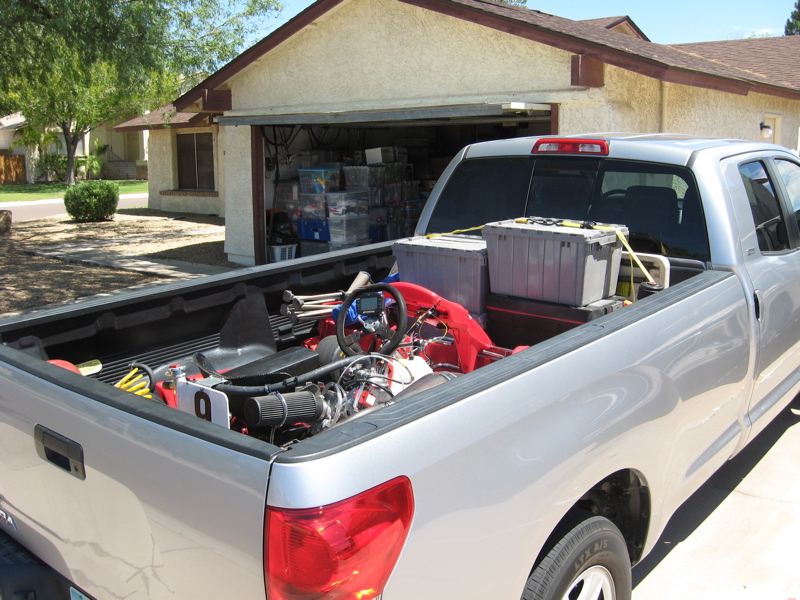
2008 Toyota Tundra – Quad cab – Long bed
Big V-8 381 hp.
Terrible to park.
Great on the highway.
12 mpg in town / 17/18 on the Hwy at 75ish.
Everything goes in the back except for our luggage.
Our kart stand is an old school fold up stand.
Fits under the kart, no wheels.
Everything is low profile, very good at speed.
Hard to see into, never had a problem when we stopped. -
August 8, 2013 at 9:01 am #6463Benn HerrParticipant
Kelly,
Click on the persons name and in the next screen click on the Private Message box.
-
August 6, 2013 at 6:00 pm #6263Benn HerrParticipant
Well sure it’ll be hot, but still cooler than Phoenix!
The dates may be just what is available, even a year out.
Nice list but a couple of corrections:
The Briggs Animal class is actually World Formula Sit-Up (CIK bodywork).
Some of those may be Briggs Sportsman (laydown), George Morland is one of them.
So if people can make those corrections and preferences known, we can get a good idea of what people want.
-
August 5, 2013 at 10:26 am #6078Benn HerrParticipant
Beck,
You could post the list on the old forum for now. I know that formatting thing is a bear! -
July 31, 2013 at 3:05 pm #5499Benn HerrParticipant
I don’t believe Linda is saying that it is a bad thing. Getting people (veteran/new) to roadrace, benifits everyone in roadracing. People who race VERY LITTLE (1-2 races a year possibly) need to understand that those who have a series such as we do under KART/MARRS which has a 7-8 race series is that even though we all believe racing at COTA would be a once in a life time experience, if we as racers where there are SEVERAL races at the present time decide to not support those events and support this event, then there is a GREAT chance of loosing some races(tracks) or even the series in there area they race in. Then what do ROADRACERS do??
As I posted earlier, I will do what I can as for scheduling around this date (if it goes off) but, our series comes first. This comes from someone who travels to other parts of the country to race but supports his own series FIRST.
I hope this race can happen as I want to see how many of those who say YES, will actually show as some who have posted here also said they were going to HPT in 2011 and didn’t show.The one thing that Road Racing needs is NEW bodies. While it is a fine thing to hold costs down and have a series that everybody is comfortable with – not too much travel, not too expensive – in the end it’s not sustainable. While your racers may love the racing they do and are ready to make another run at the championship next year, life has a way of changing that. Their kids grow up and have things to go to, they lose a job, get divorced, have surgeries, and sometimes racers just get older and pass away. Once you lose you base of customers it only gets worse.
That’s what happened to the SCK in California. Formed when Road Racing was going through some changes, and every time karting changed, they stayed on top of it and adapted. When the KT100 came out, when bodywork got popular, when sit-up classes got big. SCK was the place to be for all of these and they were constantly getting new members. Then things outside of karting changed. Tracks got expensive, and there were other kinds of racing that were more appealing. Just being the place you went to Road Race wasn’t enough. Participation dropped, not so low that they couldn’t put on races but they had to go into survival mode. Limited numbers of races, streamline the operation, lean on the volunteers, take less desirable track dates because it’s cheaper, one day races, etc….
It works for a while but have a couple bad events and you’re out of business.
The only way to stay out of this death spiral is to get new racers. And things like the USKGP are what does that. In karting the current biggest growing group is SKUSA. They put on events that people want to race in and there are championships to win but they also have the Supernats, a big event that gets a lot of notoriety, it creates a lot of “buzz”. SKUSA would be just another race promotion company without the Supernats. Every well run sport has a premier event to provide an attention focus. Road Racing used to have a couple, Daytona and Road America. But now, one is gone and the other is getting a little old. We need a high point, something special that will capture the imagination of the potential Road Racer. We need to work hard to schedule around this event. Is there a risk you might lose a race date you currently have? Yes. But you’ll lose that date anyway as soon as somebody comes along with more money. The only way to win that battle is to have more money and the only way to do that is with more racers. Make it so racers from your area can run it without a schedule conflict. We have a year to do it. It’ll be worth it.
-
July 31, 2013 at 11:46 am #5447Benn HerrParticipant
We paid him to do that.
-
March 7, 2014 at 12:14 pm #23440Benn HerrParticipant
I hope more of these kinds of events can work out.
They will take some getting used to. Fitting the usual class structure into the schedule will probably need some adjustments but nothing that can’t be figured out.
Harder to do may be getting the event officials used to how karters operate. Most car groups are used to having the cars all lined up with the drivers belted in and the engine idling. When the track is ready the wave the cars out. Karts are the opposite. When the track is ready, you start up and go – no waiting around! The car guys we run with are used to it now and give us an estimate to when the track will be ready. We usually start up at a two minute warning.
They also may be concerned on how close the karts run to each other. Corvette and Porsche guys don’t draft like we do! It will probably help that the group you’re with is a racing organization, they’ll be more understanding.
The karters will need to make some adjustments too. Groups like these run to a schedule. When you slot comes up, it’s time to go. If you’ve run at some of the Laguna Seca events with the professional run series you know what it’s like.
One thing you might look at is timing every session (if their scoring people can do it). That way, if somebody can’t make the Qual session you still have a representative time for their grid spot. We just take their best lap time from any of the three Practice/Qualifying sessions and use it for our lineup. The scoring software does it automatically.
Like I said, I hope this will work out, long track karting is what I love.
P.S. I never considered us to be a “faction” – it sounds so evil!
-
-
AuthorPosts
Search Forums