Forum Replies Created
-
AuthorPosts
-
Ian HarrisonParticipant
[quote quote=22424]Never mind……I just looked at some decent pictures of a 2005 cylinder for sale….it appears that the bolt circle and bore are concentric unlike the 2002-2004 version. Flat Top piston and chamber it is! [/quote]
That’s right Dan, the ’05 went back to the bore being concentric with the bolt circle.
Flat top piston and chamber is the way to go!Ian :-)
Ian HarrisonParticipantHi Brian
I would think you should have 50 Hp at present if your not exceeding 9,500. (You can see above that we have 56Hp at 9,500rpm).
The limiting factors will be compression ratio (too high?), ignition (Too much advance above 9,750 rpm) and pipe (depending on the rpm range and exhaust duration that it’s designed for)
I do have your mail. I should get to it tomorrow . . . . . Bloody hectic!!
Apologies to the people who are waiting for product, exhausts, heads, ignitions, etc. I expect to be fully caught up by the end of next week and thank you for your patience. This time of the year is always madness.
The new engine has taken over my life for the last 6 months, . . . . but we are getting there.
Best Regards
Ian
Ian HarrisonParticipantOn our race motors, we use the ’01 Honda Generator with Viper HPI box. This is a great race system, but generally speaking, it won’t operate powervalve, powerjet or work with TPS.
I think we are there now with a system that runs from the ’05-’07 generator. We are testing this year on our own karts. This comes in 2 versions. The first is as above, the second can run with powervalve, powerjet and TPS.
Here’s a dyno run of one of our CR250’s. It has over-rev to 11,500, but this run is only to 10,900:
[URL=http://s186.photobucket.com/user/Viperracinguk/media/Daltonsex.jpg.html][IMG]http://i186.photobucket.com/albums/x26/Viperracinguk/Daltonsex.jpg[/IMG][/URL]
You can zoom in by holding down the Ctrl key and tapping the + key
Ctrl and 0 (zero) to go back to normal
Ian HarrisonParticipantHi Guys
The early 1986/1987 reed block with the nylon stuffer is probably the best until you get upward of 10,500rpm. The stock Honda reed petals are fine, but this one is fitted with 2-stage Boyesens. Just cut of your inlet rubber level if it has protrusions and shape the stuffer and rubber to blend in nicely. Loads on Ebay
The what’s next question is always difficult. Depends on your intended use and where you want to end up.
Pipe, Ignition, Porting and head
Best Regards
Ian :-)
Ian HarrisonParticipantHi Larry
Good points and I have your e-mail on the same subject. What you have asked is a very wide ranging subject, which will take a good deal of thought and time to answer in a way that will help everyone. I’ll put my mind to it next week. For the last few months and the next few days 99% of my focus is on completing and achieving registration, in the UK, for our new Viper SK250S (250cc single cylinder) Superkart motor.


 Ian HarrisonParticipant
There!!! By far the best place. Drill and tap for an 8mm Time-Sert into the redundant gallery and cross drill into the crank chamber. Then bolt in an 8mm pulse nipple, or you can use a banjo union if desired.
 Ian HarrisonParticipant
Thanks, Sam
Ian :-)
Ian HarrisonParticipantHi Gerry
Here’s the info on tyre circumferance and height.
Fronts
33 ½” (on 125mm/5″ wide rims) = 850.9mm, Ride Height = 135.4mm
33″ (on 150mm/6″ wide rims) = 838.2mm, Ride Height = 133.4mm
Tolerance: +/- 3.2mm on front tyres circumference
Rears
34 ¾” (on 200mm/8″ wide rims) = 882.65mm, Ride Height = 140.5mm
34 1/4″ (on 230mm/9″ wide rims) = 869.95mm, Ride Height = 138.5mm
Tolerance: +/- 6.4mm on rear tyre circumference
Ride heights are calcualted from circumferance measurement and are from centre of axle to O/D of unloaded tyre. Of course the actual ride height will vary from this figure dependant on tyre pressure and load, but it will give you an idea.
The difference in ride height from 5″ to 6″ wide front rims and 8″ to 9″ rear rims is 2mm (4mm on diameter).
I was thinking more about why Hoosier recommended the 6″ front and it was probably due to them carrying out an awful lot of the initial testing with Erik Frank, who ran a PVP chassis, which like Aussie Brian Stockman’s Stockman MR2 chassis and the UK made Formula 1 chassis seem to work better with a 6″ wide front rim.
Best Regards
Ian :-)
Ian HarrisonParticipantHi Gerry
I don’t really know why Hoosier recommend (and it’s only a recommendation) a 6″ wide front, just historical I believe. Certainly nothing structural or safety related. We are working with Hoosier and supplying them with our testing info. They certainly encouraged us to try both rims and were very interested in us reporting the results to them.
I have the height/circumference detail at work, but the difference is small. I’ll post it up as soon as I can.
The general info is here but only relates to 6″ wide front and 8-9″ Rear: http://www.hoosiertire.com/specsk.htm
Best Regards
Ian :-)
Ian HarrisonParticipantHi Jim
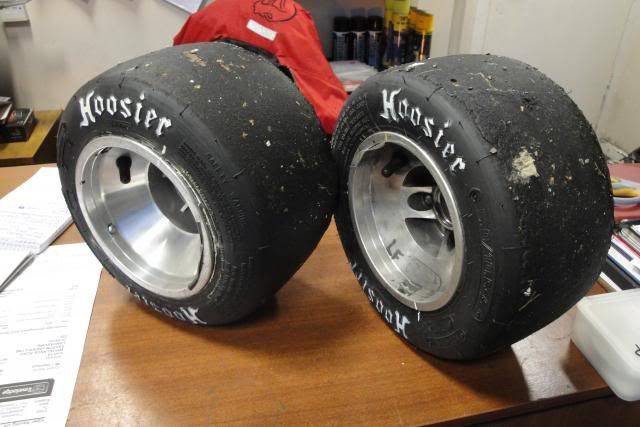
We tried the Hoosiers on both 5 and 6″ wide fronts on our Andersion Maverick chassis. (We are the Hoosiers distributors in the UK from 1st Jan 2014)
We were also very interested to read their recommendation regarding running the fronts on 6″ wide rims, so we tested them with one of our drivers on an Anderson Maverick chassis.
Personal choice of course, but he much preferred the feel and feedback when mounted on the 5″ wide rims and his lap times reflected that.
The “overhang” that Chris mentions is actually less than with the 5.5″ Dunlops (as you would expect being 0.5″ narrower).
Anyway, please see the attached picture with the Hoosiers mounted on 6″ wide rim (left) and 5″ wide rim (right). I hope the info helps. I would certainly give it a go, before lashing out on wheels. Dean Martin also runs the Hoosiers on a Maverick, so it might be worth asking his opinion.
Oh, incidentally we ran the rears on 8″ wides with bead screws on the back and front of the rim. We ran bead screws front and back of the rims on the 6″ wide fronts, but without bead screws on the 5″ wide fronts, just as we do with the Dunlops. The Hoosiers are a much stiffer carcase than the Dunlops, so require a bit more physical effort to fit!
We were extremely pleased with the results and they were comparable grip to the Dunlop DES, but with improved durability. We are running/selling the R60A which Hoosier have CIK homologated for use in UK/Europe.
Best Regards
Ian :-)
 Ian HarrisonParticipant
Hi Mike
Congrats to BB and all who took part.
Is there a website, etc. where we can see results?
Best Regards
Ian :-)
Ian HarrisonParticipantNot sure I believe that? As far as I’m aware Canada is supplied Honda Parts Via American Honda Motor Co. and the dealers use their Fiche.
Here’s Rocky Mountain Honda Powerhouse . . . . .Calgary
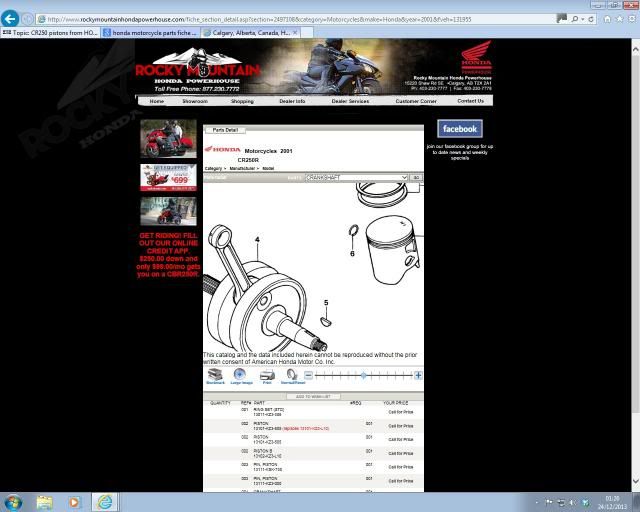
Here’s the link. Just click: http://www.rockymountainhondapowerhouse.com/fiche_section_detail.asp?section=2497108&category=Motorcycles&make=Honda&year=2001&fveh=131955
Sounds like you got a lazy parts man who doesn’t know his supersessions
Piston A 2nd Item down
Piston B 4th item down
What can happen is they see the A piston has changed to 13101-KZ3-505 from 13101-KZ3-L10 and expect the B to have changed to 13102-KZ3-505 from 13102-KZ3-L10, but probably Honda have a bucket load of the old B’s left so the part number stays the same until they run out. The parts man types in 13102-KZ3-505 and of course it doesn’t exist!!
I can’t see why you can’t obtain anything on that fiche. If your parts man is giving you grief, just try Rocky Mountain and see if you get the same answer. Quoting the part # always helps, but of course the onus is then on you to get it right!
Best Regards
Ian :-)
Ian HarrisonParticipantNigel, Not sure who told you that Honda discontinued B pistons for the CR125, but it ain’t so!! A and B still freely available.
Yes, 0.06-0.08mm is fine for the ’01 motor.
Best Regards
Ian :-)
Ian HarrisonParticipant13101-KZ3-505 – A
13102-KZ3-L10 – B
Most aftermarket companies do A,B,C and D and some E increasing in size increments of 0.01mm
Best Regards
Ian
Ian HarrisonParticipantAlan,
Not sure what dimensions you are wanting metric??
Superkart tyres are sized in imperial units i.e. 5.00″ wide x 6″ dia, 5.50″ wide x 6.00″ dia, 8.00″ wide x 6″ dia, 8.10″ wide x 6.00″ dia. etc, etc.
Wheel widths will be referred to in either inches or mm (approximations) depending on which part of the world you come from i.e. 8″ wide = 200mm, 5″ wide = 120mm etc.
The main manufacturer of Superkart wheels is Ross Edwards in Australia. I believe that they are imported into the US by Burris????
Best Regards
Ian :-)
Ian HarrisonParticipantHi Mark
The excess of rear grip that manifests itself through the rear end hopping was a characteristic of the older F1 chassis, which was a bit soft for a 250 single. Virtually impossible to cure 100%
As you have found you have to drive round it by just giving enough throttle to smoothly break rear traction, any more than that and you get the grip-release-grip-release situation that manifests itself as hopping. Either way it doesn’t make for good lap times and the hopping is tedious, tiring and destructive!
I’m afraid that I don’t have hands-on experience of the newer chassis that Chris Purdie (CPR) produces, but I know that he has been addressing that issue.
Best Regards
Ian :-)
Ian HarrisonParticipantHi Greg and Mark
Yes indeed that’s a ’97
Here’s a link that CR250 people will find useful:
http://www.oem-cycle.com/HONDACR250BIKEID.shtml
Best Regards
Ian :-)
Ian HarrisonParticipantHopefully this works guys.
Click on the link and save a copy, with the compliments of Viper Racing UK.
https://www.dropbox.com/s/jmryaap4w37fm2n/CR250%20Speed%20Calculator.xls
Best Regards
Ian :-)
Ian HarrisonParticipantHere’s a screenshot:
 Ian HarrisonParticipant
Hi James
That’s OK as far as it goes, but it’s pretty basic and doesn’t display enough information at one time, so makes it more difficult to make a quick judgement. But it works and it provides the necessary info.
Mine gives a more comprehensive display i.e. speed in each gear in kph and mph in 500 rpm increments and includes a list of the Viper alternative gear ratios to input if required.
I’ll try and put up a screen shot of mine, tomorrow (but the display area on this forum is crap!!) and work out a dropbox so that anyone can download it.
Best Regards
Ian
Ian HarrisonParticipantHi Gerry
Drop me a mail on sales@viper-racinguk.co.uk and I’ll e-mail what you need.
Best Regards
Ian
Ian HarrisonParticipantHi Nigel
CS30 is an O/E bearing number and only supplied to manufacturers under that reference and not supplied through the bearing resellers. It is a special 2-stroke crankshaft bearing designed to operate in the limited lubrication situation of a 2-stroke engine. It has a special heat-treatment of the bearing cage and specific running clearance.
Honda Part #: 91008-KAE-731
Never use the general engineering bearing 63/28 C3 or C4. These get sold a lot on Ebay etc. and you probably get away with it in a crosser.
But then you knew all that ;-)
Best Regards
Ian :-)
Ian HarrisonParticipantHi Guys
Here is a link to the results fot those interested.
http://www.tsl-timing.com/brscc/2013/134231krt.pdf
Best Regards
Ian :-)
Ian HarrisonParticipantHi Chris
We have to use 99 Octane unleadead, which is what the dyno runs were done with.
We have also run MS109 unleaded, which gives great power, but is like a dry-Martini for your engine. Get the jetting wrong and it’ll end in tears!
I also test on Q16 (for the US market) and Avgas 100LL (for the Aus market).
With either of the latter fuels you can run much higher compression and ignition advance, without detonation, but I have found the trade-off between bottom-end power and over-rev renders little or no impression in terms of actual lap time.
Best Regards
Ian :-)
Ian HarrisonParticipantHi Joel
The 2001 is a “jug read” motor (reed block on the cylinder)
The 2002 and 2003 are “case reed” (read block on the crankcase).
Engine numbers are on a small stainless steel plate riveted onto the crankcase next to where the gearchange shaft goes in.
The first 2 numbers indicate the year:
63 = 2001
64 = 2002
65 = 2003
Best Regards
Ian :-)
-
AuthorPosts







Archives