Fast Five: Gerald Caseley – Cup Karts Canada
CKNA Canada promoter provides insight into fifth season of program north of the border

 The Cup Karts North America celebrates four divisional programs that not only span the eastern portion of the USA but also into Canada. Cup Karts Canada is entering its fifth season with not only a three-event championship program, but the launch of the new Canadian 4-Cycle Nationals to open up 2026 in just three weeks.
Leading the charge for Cup Karts Canada is Gerald Caseley. The Canadian karting industry veteran began working with CKNA as early as 2020 before formulating the Cup Karts Canada program for the 2022 season.
EKN caught up with Caseley to outline the 2026 season for Cup Karts Canada, including the upcoming Canadian 4-Cycle Nationals.
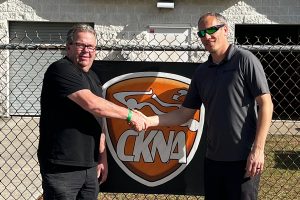
Gerald Caseley and Greg Jasperson following the agreement of CKNA Canada Division (Photo: cupkarts.com)
eKartingNews: Cup Karts Canada is entering its fifth season of competition. Looking back to the first season in 2022 and now going into what should be the biggest season yet, what are some of the highlights as a promoter of this grassroots program?
Gerald Caseley: Looking back to 2022, the biggest highlight for me is seeing how this program has grown into more than just a race series it’s become a true community.
When I first went to the United States and experienced Cup Karts North America, I saw something that really resonated with me. It wasn’t just about racing, it was about accessibility, fairness, and a culture where people genuinely help each other. That’s what I wanted to bring to Canada.
From day one, the reception here was strong, but what I’m most proud of is how we’ve built what I call a “Cup Culture.” It’s competitive, but it still feels like a club like a family. If someone needs help, people step up. That’s not something you can force; that comes from the racers themselves.
As a promoter, I’ve always believed racers are our customers. You have to listen, stay grounded, and keep their experience at the center of everything you do. We’ve worked hard to do that, and I think that’s a big part of why the program continues to grow.
Now heading into our fifth season, and with the first-ever Canadian 4-Cycle Nationals on the horizon, it feels like everything we’ve been building is coming together. But at the end of the day, the goal hasn’t changed. Keep it fair, keep it fun, and keep that community strong.
EKN: Let’s jump into the inaugural Canadian 4-Cycle Nationals. Entries have surpassed the 200 mark for the May 15-17 event at the Académie TAG Karting in Mont-Tremblant, Quebec. What led to the decision to launch this new one-off event and why start the season with the ‘Big One’?
GC: Honestly, this event has been a long time coming.
Over the past few years, with Cup Karts Canada, we’ve seen steady growth across the country, not just in numbers, but in culture. The four-cycle community in Canada has always been strong at the grassroots level, but there’s never really been a true national stage event that brings everyone together under one roof.
That’s really what led to the decision. We felt the timing was right to build something bigger, something that gives Canadian four-cycle racers a true championship to aim for, while still staying true to what this program is all about.
Starting the season with it was intentional.
We wanted to make a statement right out of the gate. If we’re going to do a national championship, we didn’t want it to feel like just another race at the end of the year. We wanted it to stand on its own. By putting it up front, it becomes a destination event. It builds excitement early, it sets the tone for the season, and it gives everyone something to rally around right away.
And when you look at some of the most successful motorsports promoters out there, like IMSA and NASCAR, they both kick off their seasons with their biggest events. That model works, and it made a lot of sense for us to follow that same approach.
And I think the response speaks for itself. To see over 200 entries already for a first year event at Académie TAG Karting, that’s pretty special.
At the end of the day, this wasn’t about creating just another race. It was about creating a moment for Canadian four-cycle karting and giving racers and families something they can be proud to be part of.
 EKN: The inaugural Canadian 4-Cycle Nationals will lead into the 2026 season for the CKNA Canada division. This year will include visits to Brechin Motorsports Park (June), Lombardy Motorsports Park (July) and back to Quebec at the Karting Trois-Rivières (September). Fill in for the karting community how the schedule came about in selecting the dates and facilities.
GC: When we put the schedule together, it really comes down to where we’ve been and what worked, and what we feel gives our racers the best overall experience.
We were at Brechin Motorsports Park last year and honestly it was kind of a hidden gem for us. The track itself is built more along CIK lines, it’s wide, there’s room to race, and you can actually race side by side instead of just following each other. But what really stood out to me was the way the facility works. From a promoter side, everything just flows. The grid is probably one of the best I’ve seen, it’s four lanes wide and can handle full fields without everything getting backed up. Timing, layout, all of it just made sense. It’s not the biggest place, but you can tell the owner has put a lot of effort into improving it. We left there last year saying we had to come back. We moved the date a little this year just to give guys a bit more time in early June to get their stuff together.
Then we go to Lombardy Motorsports Park, which a lot of people already know and like. It’s another one that maybe doesn’t jump out at you at first, but the racing is always good there. The facility is clean, there’s lots of room, and the area itself is nice. It ends up being a bit of a destination which is important for families, not just racers. And being able to run it both directions is something we like too.
And then finishing at Karting Trois-Rivières kind of brings it full circle. That’s where it all started for us. It wasn’t even really planned at first this year, but after talking with them and hearing they were going to repave and put work into the facility, it just made sense to go back. The track is fun and the feedback the first time we went there was really good.
So really the schedule just came from going back to places that race well and work well and trying to build something that makes sense for the racers and their families.
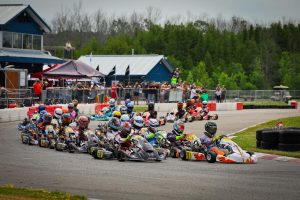
Fields continue to grow at CKNA Canada (Photo: Cup Karts Canada)
EKN: The class structure remains the same for the 2026 season. Are there any changes from last year heading into the new year?
GC: The class structure stays largely the same for 2026. It’s been working well, so we haven’t made any major changes.
From the start, a lot of karting in Canada has been built around combined classes, especially with two-stroke programs, so you usually see one Senior and one Masters. What we’ve focused on is building depth within four-cycle by separating those out.
Classes like Senior Medium are a good example. Early on, not many racers really understood where they fit, but that’s been growing. We saw strong numbers last year and it’s continuing this season. Same with Masters, Legends, and Heavy. Instead of combining them, we’ve split them up so racers have a better place to compete.
It’s something that’s been building year over year and we’ll keep growing it that way.
We do have something new coming that we’re excited about, but we’re not ready to release it yet. We’ll be announcing it at the drivers’ meeting at the Canadian Nationals.
EKN: Over the last few seasons, we have seen a handful of drivers from the United States crossing over the border to compete at CKNA Canada divisions. Looking at the entry lists for the Canadian 4-Cycle Nationals, there will be a few more competing in this one-off event. What advice or tips do you have for competitors coming across the border to compete in Canada?
GC: I think one thing a lot of people don’t always realize right away is the exchange rate. Right now, the U.S. dollar goes a long way up here. If you’re looking at a $200 registration, that’s really closer to about $120–$130 U.S. depending on the day. Same thing applies to a lot of your weekend costs, so it does make the trip a little easier on the wallet than people might expect.
As far as the border goes, I took the time this winter coming back from Florida to ask the question directly. On the Canadian side, they told me you don’t necessarily need a passport to get into Canada. A driver’s license and a birth certificate or proof of citizenship can be enough. That said, I’d still recommend bringing a passport if you have one just to keep things simple, especially for getting back into the U.S. That part can be a little different depending on who you talk to.
For the racers that have already come up, most of them say the process is pretty straightforward. You pull up, tell them you’re heading to a karting race, they’ll ask what’s in the trailer, you tell them karts and equipment, and you’re on your way. It’s not nearly as complicated as people sometimes think.
Beyond that, I’d just say come up with an open mind and be ready to enjoy it. Our paddock is very welcoming, it’s a bit of a different feel, but in a good way. We’ve had a few U.S. drivers come up over the last couple years, and they’ve had a great time, and we’d honestly like to see more of it, especially from the northeast where the trip is pretty manageable.
At the end of the day, it’s good racing, good people, and a bit of a different experience, and I think once people make the trip once, they usually want to come back.
EKN: Thank you Gerald. We hope the inaugural Nationals goes off as well as expect and the rest of the 2026 is your best season yet.
GC: Thank you and we’ll see everyone Canadian 4-Cycle Nationals.












Archives